Welcome to the ultimate tech showdown that has captivated users worldwide! For over a decade, two giants have dominated the smartphone market with their innovative approaches. Each brand brings something unique to the table, creating passionate fan bases on both sides.
Apple is known for its sleek design and seamless integration across devices. Their ecosystem offers a smooth user experience with strong security and regular software updates. Many users appreciate the premium feel and consistent quality.
Samsung pushes boundaries with cutting-edge hardware and incredible flexibility. They offer a wide range of devices at various price points, giving users more choice. Their displays and camera systems often lead the market in innovation.
We’re here to help you understand which ecosystem truly wins for gadget lovers. This isn’t just about phones – it’s about how your devices work together in daily life. We’ll explore performance, design, camera quality, and overall user experience to help you make the best choice.
Key Takeaways
- Apple focuses on seamless integration and premium design across its product lineup
- Samsung offers greater flexibility and innovation in hardware features
- Both ecosystems provide strong security and regular software updates
- Camera quality and display technology are standout features for both brands
- Battery life performance varies across different models and usage patterns
- The choice ultimately depends on your personal preferences and budget
- Each ecosystem offers unique advantages for different types of users
Introduction: The Defining Tech Rivalry
This isn’t just about choosing a phone – it’s about selecting your digital lifestyle for years to come. The competition between these tech giants has transformed into something much larger than device specifications. It’s about how technology integrates into every aspect of your daily routine.
We’re here to help you understand what this means for your tech journey. The stakes have never been higher for enthusiasts who want the best experience from their gadgets.

The Stakes for Gadget Lovers
For technology enthusiasts, this choice impacts everything from daily convenience to long-term investments. Your decision affects accessory compatibility, service subscriptions, and future upgrade paths.
The right ecosystem can transform how you work, play, and connect. It determines how smoothly your devices communicate and share information.
Consider these important factors:
- Daily usability – How intuitive is the interface for your regular activities?
- Accessory ecosystem – What additional products work seamlessly with your chosen platform?
- Long-term value – How well will your investment hold up over time?
- Local support – What services and repairs are available in your region?
For Nigerian users, pricing and availability become crucial considerations. The value proposition must include local service centers and warranty support.
What “Ecosystem” Really Means in 2026
Today’s technology ecosystem represents seamless connectivity across all your devices. It’s the invisible thread that ties your digital life together.
Apple’s approach creates a tightly integrated environment. Their products work together with remarkable consistency. This controlled environment prioritizes privacy and simplicity.
Samsung offers a more open architecture. Their Galaxy devices connect with various platforms and services. This flexibility allows for greater personalization options.
Key ecosystem components include:
- Cross-device functionality and file sharing
- Unified security protocols and data protection
- Consistent software updates across product lines
- Shared services and subscription benefits
The concept of ecosystem lock-in is real. If you already own products from one brand, switching becomes more challenging. This makes your initial choice particularly important for long-term satisfaction.
Each platform appeals to different user preferences. Some value Apple’s consistent experience and privacy focus. Others prefer Samsung’s innovative features and customization options.
Your ideal choice depends on what matters most in your digital life. We’ll help you navigate these considerations throughout our detailed comparison.
2026 Lineup and Price Tiers: From Budget to Ultra-Premium
Understanding the pricing structure of top brands helps you make smarter purchasing decisions. We’ll break down each company’s approach to different market segments.
Both manufacturers offer distinct strategies for budget-conscious and premium-seeking users. Your ideal choice depends on what features matter most to your daily use.
Apple’s iPhone Strategy: SE, Standard, and Pro Models
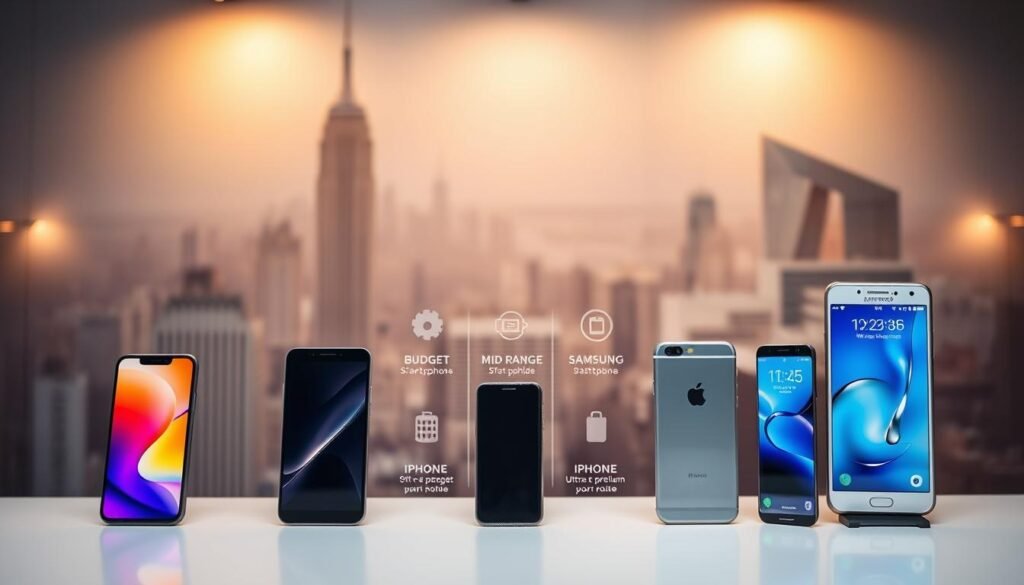
Apple maintains a clear three-tier approach to their mobile offerings. The SE model serves budget-conscious users around $399.
Standard models provide balanced performance between $799-$899. These devices offer excellent everyday functionality.
Pro models reach up to $1,499 with premium features. They include advanced camera systems and 120Hz displays.
Key advantages include:
- Long software support – Regular updates for several years
- Premium materials – Ceramic Shield durability and quality construction
- Powerful chips – A-series processors for smooth performance
Samsung’s Galaxy Arsenal: A-Series, S-Series, and Innovative Z-Series
Samsung offers broader options across price points. The A-Series starts from $200 for basic needs.
S-Series flagships range from $799-$1,199. They deliver top-tier performance and innovation.
The Z-Series foldables cost $999-$1,800+. These represent cutting-edge display technology.
Notable features include:
- AMOLED displays – Vibrant colors and deep blacks
- AI-powered cameras – Smart photography enhancements
- Flexible designs – Foldable screens for unique form factors
Value Proposition for the Nigerian Market
Nigerian consumers face unique considerations when choosing devices. Import costs and local availability significantly impact final pricing.
Budget models like iPhone SE and Galaxy A-Series offer excellent value. They provide essential features without premium costs.
Premium tiers target professionals and enthusiasts. These models justify their higher prices with advanced capabilities.
We recommend considering:
- Local warranty support – Service center availability
- Battery performance – Adaptation to local power conditions
- Resale value – Long-term investment protection
Students often find budget models sufficient for daily tasks. Professionals may prefer premium devices for demanding workloads.
Your decision should balance immediate costs with long-term value. Consider how each device will perform in Nigeria’s specific market conditions.
Design Philosophy and Build Quality: Minimalism vs. Innovation
How your phone feels in hand and withstands daily use reveals much about each brand’s philosophy. We examine how design choices affect real-world experience beyond mere appearance.
Both approaches offer distinct advantages for different users. Your preference depends on what you value most in daily device interaction.
Apple’s Signature Aesthetic: Materials and Durability
Apple embraces minimalism with premium materials across their product range. Their design language focuses on clean lines and consistent aesthetics.
Pro models feature titanium frames for enhanced strength-to-weight ratio. Standard versions use aerospace-grade aluminum with Ceramic Shield protection.
Key advantages include:
- Consistent quality – Uniform design language across all devices
- Excellent drop protection – Ceramic Shield front glass resists impacts
- Premium feel – Quality materials create sophisticated appearance
The flat-edge design provides secure grip during one-handed use. This approach prioritizes practical handling alongside visual appeal.
Samsung’s Bold Approach: Curves, Folds, and Futuristic Designs
Samsung pushes boundaries with innovative form factors and experimental designs. Their approach celebrates technological advancement through physical design.
The Z-Series foldables represent their most ambitious creations. These devices transform from conventional phones to miniature tablets.
Notable features include:
- Flexible displays – Cutting-edge screen technology enables new form factors
- Curved edges – Immersive viewing experience with minimal bezels
- Gorilla Glass Victus – Scratch-resistant protection on premium models
This innovative spirit comes with unique handling characteristics. The curved displays might occasionally register accidental touches.
Ergonomics and Everyday Feel
Daily comfort depends on how your device fits your hand and lifestyle. Both brands approach ergonomics from different perspectives.
Apple’s flat edges provide confident grip security. The balanced weight distribution feels comfortable during extended use.
Samsung’s curves create sleek profiles that slide easily into pockets. Their foldables offer versatility despite slightly thicker designs.
For Nigerian users, consider these practical aspects:
- Climate adaptation – Materials should withstand humid conditions
- Commute-friendly – Size and weight matter during daily transportation
- Protection needs – Consider local availability of cases and screen protectors
Your choice ultimately reflects personal style preferences. Some appreciate timeless elegance while others prefer bold innovation.
Test both designs personally if possible. The right device should feel natural in your hand and suit your daily routines.
Display Showdown: Super Retina XDR vs. Dynamic AMOLED 2X
Your phone’s display is your window to the digital world – let’s examine which brand offers the clearest view. We’ll explore how screen technology impacts everything from gaming to everyday browsing.
Both companies invest heavily in display innovation. Each approach brings distinct advantages for different types of users.
Resolution, Brightness, and Pixel Density
Pixel density determines how sharp text and images appear on your screen. Samsung typically offers higher numbers here.
Their latest models reach 515 pixels per inch. This creates exceptionally crisp visuals for reading and media consumption.
Apple’s displays max out around 460 PPI but compensate with other strengths. Their panels deliver up to 2000 nits peak brightness.
This extra luminosity proves valuable in sunny conditions. Nigerian users will appreciate better visibility outdoors.
Refresh Rate Battle: ProMotion vs. Adaptive LTPO
Smooth scrolling and responsive touch feel different between these technologies. Both systems dynamically adjust based on content.
Apple’s ProMotion ranges from 10Hz to 120Hz. It provides buttery smooth animations while conserving battery during static content.
Samsung’s Adaptive LTPO operates between 48Hz and 120Hz. This offers excellent performance with power efficiency.
Gaming benefits greatly from higher refresh rates. Action games feel more immediate and responsive.
Unique Features: Always-On Display and Vision Booster
Convenience features enhance daily interaction with your device. Each brand approaches this differently.
Apple’s Always-On Display shows basic information without waking the phone. This helps quickly check time and notifications.
Samsung’s Vision Booster automatically optimizes screen settings for outdoor use. It adjusts contrast and brightness in bright sunlight.
For Nigerian users facing power challenges, these features matter. They reduce unnecessary screen activation and power consumption.
Your choice depends on what screen qualities matter most. Consider whether peak brightness or pixel density aligns with your usage patterns.
Both displays offer excellent quality for multimedia and productivity. The right choice enhances your overall smartphone experience.
Camera Capabilities: Computational Photography vs. Versatile Lenses
In today’s visual world, your phone’s camera system defines much of your daily digital experience. We’re exploring how different approaches to mobile photography can transform your creative expression.
Both leading brands offer exceptional imaging capabilities. Their distinct philosophies cater to different types of photographers and content creators.
Computational Photography and Pro-Grade Video
One approach emphasizes software intelligence for image enhancement. This method uses advanced algorithms to process multiple exposures instantly.
Smart HDR technology balances highlights and shadows beautifully. It preserves detail in both bright skies and dark shadows.
Video recording reaches professional standards with these devices. Features like ProRes support enable high-quality content creation.
Key advantages include:
- Consistent results – Reliable performance across various lighting conditions
- Excellent stabilization – Smooth footage even during movement
- Color accuracy – True-to-life reproduction for authentic memories
Multi-Lens Array and AI-Powered Editing
The alternative strategy employs multiple specialized lenses. This provides incredible flexibility for different shooting scenarios.
Some models feature up to 200MP sensors for incredible detail. AI-powered tools automatically optimize scenes and remove unwanted objects.
Creative controls empower users to experiment with photography. The editing suite offers professional-grade adjustments without extra apps.
Notable features include:
- Versatile zoom capabilities – Up to 8x optical magnification for distant subjects
- AI scene optimization – Automatic adjustments for different environments
- Object removal tools – Clean up images by eliminating distractions
Performance in Challenging Conditions
Low-light photography presents unique challenges for mobile cameras. Both systems handle this differently with impressive results.
Night Mode technology brightens dark scenes without excessive noise. It preserves natural-looking colors while maintaining detail.
Zoom capabilities vary significantly between the approaches. Optical zoom provides cleaner magnification than digital alternatives.
For Nigerian users, consider these practical aspects:
- Cultural event photography – Capturing vibrant celebrations and ceremonies
- Power outage readiness – Performance during inconsistent lighting conditions
- Social media optimization – Direct sharing to popular platforms
| Feature | Computational Approach | Multi-Lens System |
|---|---|---|
| Low Light Performance | Excellent noise reduction | Good with dedicated night mode |
| Optical Zoom | Up to 5x magnification | Up to 8x magnification |
| Video Quality | ProRes support available | 4K at 60fps standard |
| AI Editing Features | Basic automatic enhancements | Advanced object removal |
| Social Media Integration | Seamless platform sharing | Creative filter options |
Practical tips can enhance your photography experience regardless of your choice. Use ProRes format for highest quality video projects.
Experiment with manual controls for creative expression. Many devices offer pro modes that unlock advanced settings.
For Nigerian content creators, consider local lighting conditions. The intense sunlight requires different approaches than overcast weather.
Your ideal choice depends on your creative priorities. Some value consistent video quality for vlogging and content creation.
Others prefer flexible shooting options and creative editing tools. Both systems offer exceptional quality for everyday use.
Test both approaches if possible before making your decision. The right camera system should feel intuitive and inspire your creativity.
Performance and Hardware: A-Series Chip vs. Snapdragon Power
What keeps your device running smoothly through demanding tasks and daily use? We’re exploring the engine rooms of these technological marvels to help you understand real-world performance differences.
Both approaches deliver exceptional processing capabilities. Their distinct philosophies cater to different usage patterns and priorities.
Raw Power: Gaming and Multitasking
Apple’s A-series chips deliver incredible single-core performance. This makes them excellent for intensive gaming sessions and complex app usage.
The A18 Pro handles resource-heavy applications with ease. It maintains smooth frame rates during extended gameplay.
Samsung’s Snapdragon processors offer strong multi-core capabilities. This provides excellent multitasking performance across various applications.
Key differences include:
- Gaming optimization – Both handle popular titles well with minor variations
- App loading speeds – Minimal differences in daily usage scenarios
- Background tasks – Multi-core strength benefits simultaneous operations
Battery Life and Charging Speeds
Battery capacity varies significantly between these approaches. One brand focuses on software optimization for efficiency.
Their devices typically feature around 3349 mAh batteries. This provides solid all-day performance for most users.
The alternative offers larger 5000 mAh batteries in premium models. This extra capacity supports extended usage between charges.
Charging speeds differ noticeably between the platforms. Some models support significantly faster charging technologies.
For Nigerian users facing power challenges, consider:
- Power outage readiness – Larger batteries provide longer usage during outages
- Charging availability – Faster charging helps when power access is limited
- Battery health – Long-term capacity retention matters for device longevity
Thermal Management and Long-Term Performance
Heat management affects both immediate performance and device lifespan. Each brand approaches this challenge differently.
One system uses advanced efficiency measures to minimize heat generation. This maintains consistent performance during extended use.
The alternative employs AI optimization to manage thermal output. It dynamically adjusts performance based on temperature readings.
Long-term reliability depends on proper thermal management. Both systems offer excellent durability when used appropriately.
Consider these factors for your usage patterns:
- Gaming sessions – Extended play requires effective cooling
- Outdoor use – Nigerian climate demands good heat dissipation
- Future-proofing – Proper cooling preserves performance over years
Your ideal choice depends on how you use your device daily. Gamers might prefer raw power while professionals value reliability.
Test both systems if possible before making your decision. The right hardware should feel responsive and dependable for your needs.
The Core Software Experience: iOS 18 vs. Android 15 & One UI
The operating system defines your daily interaction with technology more than any hardware feature. It’s the invisible framework that shapes how you communicate, work, and play with your device.
We’re exploring two distinct approaches to mobile software design. Each philosophy offers unique advantages for different types of users and lifestyles.
Your choice here impacts everything from basic navigation to long-term device satisfaction. The right software should feel intuitive and supportive of your daily routines.
iOS 18: Simplicity, Privacy, and Apple Intelligence
This platform emphasizes clean design and straightforward operation. The interface prioritizes ease of use with consistent navigation patterns.
Privacy protection stands as a cornerstone of this experience. Built-in features limit data collection and provide transparency about information usage.
The latest intelligence features enhance everyday convenience. These tools help with writing suggestions, image creation, and task automation.
Key advantages include:
- Uniform experience – Consistent interface across all supported devices
- Strong security – Regular security patches and privacy-focused design
- Smart assistance – AI features that work across applications
- Accessibility – Comprehensive tools for users with different needs
Android 15 & One UI: Customization, Flexibility, and Galaxy AI
This environment celebrates personal expression and user control. The interface allows extensive customization of appearance and functionality.
Flexibility extends to how you interact with applications and services. Users can choose default apps for various tasks and services.
Galaxy AI tools bring advanced capabilities to everyday use. These features enhance photography, translation, and productivity tasks.
Notable features include:
- Theme customization – Complete control over colors, icons, and layouts
- Multi-tasking – Split-screen and floating window support
- AI productivity – Smart suggestions and automation tools
- Third-party integration – Compatibility with various services and platforms
Update Policies and Long-Term Software Support
Software updates ensure your device remains secure and functional over time. Both companies offer robust support policies with some differences.
One platform typically provides five years or more of regular updates. This ensures devices receive the latest features and security improvements.
The alternative offers four to five years of support with timely security patches. Update delivery speed may vary depending on region and carrier.
For Nigerian users, consider these practical aspects:
- Update reliability – Consistent delivery regardless of location
- Security concerns – Regular protection against emerging threats
- Feature accessibility – Availability of latest tools in your region
- Device longevity – Extended usability through software support
| Feature Category | Streamlined Approach | Flexible Platform |
|---|---|---|
| Interface Customization | Limited theme options | Extensive personalization |
| Default App Selection | Restricted to built-in apps | Open to third-party alternatives |
| Update Duration | 5+ years guaranteed | 4-5 years with security updates |
| AI Integration | Built-in intelligence features | Galaxy AI with creative tools |
| Privacy Controls | Comprehensive data protection | Configurable privacy settings |
| Regional Support | Consistent global rollout | Variable update timing |
Your ideal software choice depends on what matters most in your digital life. Some users value simplicity and consistent performance above all else.
Others prefer flexibility and personalization options. Both platforms offer excellent quality for different types of users.
Consider testing both interfaces if possible before making your decision. The right software should feel natural and support your daily activities effortlessly.
Beyond the Phone: Ecosystem Integration and Lock-In
Your smartphone becomes much more powerful when it connects seamlessly with your other gadgets. We’re exploring how each platform extends beyond mobile devices to create complete digital environments.
This integration affects everything from productivity to entertainment. The right ecosystem makes your devices work together like a well-trained team.
Apple’s Walled Garden: Watches, Tablets, and Macs
Apple creates a tightly integrated environment where everything works together perfectly. Their approach focuses on consistency and reliability across all products.
The magic happens when your devices recognize each other instantly. Your Apple Watch unlocks your Mac without passwords. Your iPad becomes a second screen for your computer.
Key advantages include:
- Instant pairing – Devices connect automatically without complicated setup
- Shared clipboard – Copy text on one device, paste on another
- Universal control – Single mouse and keyboard works across multiple screens
- Health data sync – Fitness information updates across all devices
This environment offers exceptional convenience but limits mixing with other brands. Once you invest in multiple Apple products, switching becomes challenging.
Samsung’s Open Galaxy: TVs, Watches, and Windows PCs
Samsung embraces flexibility with their connected environment. Their ecosystem welcomes various brands and platforms into the experience.
Your Galaxy phone can control Samsung TVs and appliances. It also works well with Windows computers and other Android devices.
Notable features include:
- Multi-control – Use your phone as touchpad for your PC
- Smart view – Mirror content to compatible TVs and displays
- Cross-platform compatibility – Works with various brands and services
- Customizable experience – Choose your preferred apps and services
This openness comes with occasional compatibility challenges. Some features might work differently across various devices and brands.
The Seamlessness of Cross-Device Functionality
True ecosystem integration means your devices anticipate your needs. They should work together without requiring constant adjustment.
Apple’s Handoff feature exemplifies this seamless experience. Start an email on your iPhone and finish it on your Mac effortlessly.
Samsung’s Multi-Control offers similar convenience. Drag files between your phone and computer like they’re one device.
For Nigerian users, consider these practical aspects:
- Local accessory availability – Which brands have good support in your area
- Power efficiency – How ecosystem features affect battery life
- Internet requirements – Data needs for cloud synchronization
- Long-term value – Investment protection through compatibility
The best ecosystem is the one that disappears into the background, working so smoothly you forget it’s there until you need it.
Real-world examples show these systems in action. Health tracking continues across watch and phone seamlessly. Media streaming adjusts between TV and mobile devices automatically.
| Integration Feature | Closed Ecosystem | Open Environment |
|---|---|---|
| Device Pairing | Automatic and instantaneous | Manual setup sometimes required |
| Cross-Platform Compatibility | Limited to own brand products | Works with various manufacturers |
| Data Synchronization | Instant and reliable | Occasional delays possible |
| Security Consistency | Uniform protection across devices | Varies by device and platform |
| Update Coordination | Simultaneous across all devices | Independent update schedules |
| Local Support Availability | Consistent service experience | Variable support quality |
Your choice depends on what matters most in your digital life. Some prefer the reliability of a unified system. Others value the freedom to choose different brands.
Consider your existing devices and future plans. The right ecosystem should support your goals without limiting your options unnecessarily.
Test both approaches if possible before committing. The ideal integration feels natural and enhances your daily routine effortlessly.
App Ecosystem and Services: App Store vs. Google Play
The digital marketplace where you download applications shapes your daily mobile experience significantly. We explore how different platforms approach app distribution and exclusive services.
Each ecosystem offers unique advantages for various types of users. Your preference depends on what matters most in your app usage patterns.
App Availability and Quality Control
Apple’s curated marketplace maintains strict standards for application quality. Their review process ensures consistent performance and security across all offerings.
The platform hosts approximately 1.9 million carefully vetted applications. This controlled environment prioritizes user safety and reliability.
Google’s alternative provides greater variety with over 2.44 million available apps. The more open approach allows faster developer publishing with less restrictive oversight.
For Nigerian users, consider these practical aspects:
- Local app availability – Regional banking and service applications
- Payment methods – Support for local transaction options
- Data efficiency – App performance under limited connectivity
Revenue Models: Premium Spending vs. Ad-Supported
User spending habits differ dramatically between these digital marketplaces. One platform’s customers average $10.4 monthly on premium applications.
This creates a lucrative environment for developers seeking profitability. High-quality paid applications thrive in this ecosystem.
The alternative ecosystem averages $1.4 monthly spending per user. This encourages more advertising-supported and freemium application models.
Key differences include:
- Developer incentives – Higher revenue attracts premium content creators
- Ad experience – Variable advertising intensity across different applications
- Subscription value – Cost-to-benefit ratio for recurring services
Exclusive Services: iMessage, FaceTime vs. Samsung Pass, Bixby
Platform-exclusive features enhance daily convenience in unique ways. These services often become deciding factors for users choosing their ecosystem.
One brand offers seamless communication tools across their device range. These services work exclusively within their product environment.
The alternative provides practical utilities like secure credential management. Their intelligent assistant helps with daily tasks and information retrieval.
For Nigerian users, these services offer particular advantages:
- Communication efficiency – Messaging performance under varying network conditions
- Security convenience – Password management without compromising safety
- Local relevance – Adaptation to regional usage patterns and needs
Your ideal choice depends on which services align with your daily routines. Some value communication tools while others prefer productivity enhancements.
Test both ecosystems if possible before making your final decision. The right platform should feel intuitive and support your lifestyle seamlessly.
Security and Privacy: Two Contrasting Approaches
How your personal information gets protected varies greatly between these tech giants. We’re exploring their distinct security philosophies to help you choose the right protection for your digital life.
Both companies take security seriously but approach it differently. One prioritizes strict control while the other offers flexible options.
Apple’s Tightly Controlled, Privacy-First Stance
Apple builds privacy directly into their system architecture. Their approach limits data collection across all applications and services.
App Tracking Transparency gives you control over which apps can track your activity. This feature prevents unwanted data sharing with third parties.
All information gets processed on your device when possible. This minimizes data sent to external servers.
Key security features include:
- End-to-end encryption – Messages and health data remain private
- Secure Enclave – Hardware protection for sensitive information
- Regular audits – Continuous monitoring for potential vulnerabilities
Samsung’s Knox Security and Android’s Flexibility
Samsung combines hardware and software protection through their Knox platform. This system creates multiple security layers for comprehensive coverage.
Knox protects your device from unauthorized access attempts. It monitors for suspicious activity and potential threats.
The Android platform offers greater customization of security settings. Users can adjust permissions and controls based on personal preferences.
Notable protection features:
- Real-time monitoring – Continuous threat detection and prevention
- Secure folder – Isolated space for sensitive files and applications
- Biometric options – Multiple authentication methods including fingerprint and facial recognition
Data Handling and User Control
How companies manage your information affects your daily security experience. Both systems offer different levels of user control.
Apple’s approach automatically restricts data access for most applications. You get clear privacy nutrition labels showing how apps use your information.
Samsung and Android provide more granular control over permissions. Users can precisely manage what each application can access.
For Nigerian users, consider these practical aspects:
- Local regulations – Compliance with Nigeria’s data protection laws
- Network security – Performance on various mobile networks
- Cyber awareness – Protection against common regional threats
Practical tips can enhance your security regardless of your choice. Regularly review app permissions and remove unnecessary access.
Enable two-factor authentication for important accounts. This adds an extra layer of protection beyond passwords.
Keep your software updated to receive the latest security patches. Both companies regularly release updates addressing vulnerabilities.
The best security system is one that works silently in the background while giving you clear control when you need it.
| Security Aspect | Controlled Environment | Flexible Platform |
|---|---|---|
| Data Collection | Minimal and transparent | User-configurable levels |
| App Permissions | Strict default restrictions | Granular user control |
| Encryption Standards | End-to-end protection | Multiple encryption options |
| Update Consistency | Regular and predictable | Variable timing |
| Local Threat Protection | Consistent global standards | Region-specific adaptations |
Your ideal choice depends on your comfort with managing security settings. Some prefer automatic protection that requires minimal intervention.
Others value the ability to customize every aspect of their security setup. Both approaches offer excellent protection when properly configured.
Consider testing both security systems if possible before deciding. The right choice should make you feel confident about your digital safety.
Price, Value, and Resale: Assessing the Long-Term Investment
Smartphone purchases represent significant financial decisions that extend beyond the initial price tag. We help you understand the complete cost picture over your device’s lifetime.
Your investment should deliver value through years of reliable service. The right choice balances upfront costs with long-term satisfaction and financial return.
Initial Cost Analysis for Nigerian Consumers
Nigerian buyers face unique pricing considerations due to import duties and distribution channels. Local market conditions significantly impact final purchase prices.
Premium models from one brand typically start around $999 internationally. Their counterparts offer flagship experiences beginning at approximately $799.
These figures often increase by 20-30% in Nigeria after import costs. Local warranty support and service availability add further value considerations.
Budget-conscious users should consider:
- Total ownership cost – Including accessories and protection plans
- Local service availability – Repair center accessibility
- Payment flexibility – Installment options and retailer financing
Longevity, Software Support, and Future-Proofing
Device longevity depends heavily on continued software updates and security patches. One platform provides 5+ years of consistent system updates.
This extended support ensures your device remains secure and functional. It also maintains compatibility with newer applications and services.
The alternative offers solid 4-5 year support with regular security updates. This timeframe covers most users’ upgrade cycles adequately.
Future-proofing considerations include:
- Update consistency – Regular delivery regardless of location
- Security maintenance – Protection against emerging threats
- Feature accessibility – New functionality through software updates
Resale Value and Market Demand
Resale value represents an important aspect of your total investment return. Some devices maintain 60-70% value after two years of use.
This strong retention stems from brand perception and update longevity. The consistent quality and security features contribute to higher demand.
Other models typically retain 40-50% value over the same period. Their wider model range and faster depreciation create more affordable secondary market options.
For Nigerian resale markets, consider these factors:
- Local brand perception – Regional popularity affects demand
- Condition maintenance – Protective cases and screen guards preserve value
- Documentation completeness – Original boxes and receipts increase resale price
| Investment Factor | Extended Support Brand | Flexible Options Brand |
|---|---|---|
| Initial Cost (Nigeria) | Higher entry price | More budget-friendly options |
| Software Support Duration | 5+ years guaranteed | 4-5 years with security updates |
| 2-Year Value Retention | 60-70% original value | 40-50% original value |
| Local Service Availability | Consistent service quality | Variable support network |
| Total Ownership Cost | Higher initial, lower long-term | Lower initial, variable long-term |
Practical tips can maximize your investment regardless of your choice. Always purchase from authorized Nigerian retailers for proper warranty coverage.
Keep original packaging and purchase documentation for better resale value. Maintain your device with protective cases and regular cleaning.
The smartest tech investment is one that serves you well today while retaining value for tomorrow.
Your ideal choice depends on your financial priorities and upgrade frequency. Some users prefer higher initial costs with better long-term value retention.
Others appreciate lower entry prices with acceptable performance throughout ownership. Both approaches offer solid value for different user profiles.
Consider testing both ecosystems if possible before committing. The right investment should feel financially comfortable while meeting your daily needs.
iPhone vs. Samsung: Which Ecosystem Wins for Gadget Lovers in 2026?
After exploring every aspect of these incredible ecosystems, it’s time to match the right platform to your lifestyle. The perfect choice isn’t about which brand is better overall, but which one fits your unique needs and preferences.
Who Should Choose the Streamlined Ecosystem?
This platform excels for those who value simplicity and reliability above all else. If you prefer things to just work without constant tweaking, this might be your ideal match.
The typical user appreciates seamless integration across all their gadgets. They enjoy how everything connects effortlessly and works together perfectly.
Privacy-conscious individuals find comfort in the strong security features. The consistent software updates provide peace of mind for years to come.
Key characteristics of ideal users include:
- Premium experience seekers – Those who appreciate high-quality materials and consistent performance
- Privacy advocates – Users who value data protection and transparent information handling
- Ecosystem investors – People who plan to use multiple devices from the same brand
- Resale value conscious – Those who consider long-term investment protection important
Young professionals and students often gravitate toward this ecosystem. The reliable performance supports both work and entertainment needs.
Who Should Choose the Flexible Alternative?
This platform shines for users who love customization and cutting-edge innovation. If you enjoy personalizing every aspect of your device, this could be your perfect fit.
The ideal user values having choices across different price points. They appreciate being able to select features that match their budget.
Tech enthusiasts who crave the latest innovations find joy here. Foldable screens and advanced camera systems offer exciting possibilities.
Notable user profiles include:
- Customization lovers – Those who enjoy personalizing their interface and features
- Budget-conscious shoppers – Users who want great value across different price ranges
- Innovation seekers – People who enjoy experimenting with new form factors and technologies
- Multi-platform users – Those who work with various brands and services
Creative professionals and gadget enthusiasts often prefer this environment. The flexibility supports diverse workflows and creative projects.
The Final Decision Based on Your Priorities
Your perfect choice depends on what matters most in your daily tech life. Both platforms offer exceptional quality but cater to different preferences.
Choose the streamlined option if you value:
- Seamless integration across all your devices
- Strong privacy protections and security features
- Consistent software updates and long-term support
- Premium build quality and resale value
Select the flexible alternative if you prefer:
- Customization options and personalization features
- Innovative hardware and cutting-edge technology
- Wider range of price points and models
- Openness to various platforms and services
The right technology should feel like an extension of yourself – enhancing your life without demanding constant attention.
For Nigerian users, local considerations add important dimensions to your decision. Service availability and pricing become crucial factors in our market.
| Priority | Recommended Choice | Key Advantages |
|---|---|---|
| Privacy & Security | Streamlined Ecosystem | Strong data protection, regular updates |
| Customization & Flexibility | Flexible Platform | Personalization options, open ecosystem |
| Ecosystem Integration | Streamlined Ecosystem | Seamless device connectivity |
| Innovation & New Features | Flexible Platform | Cutting-edge technology, foldable displays |
| Budget Considerations | Flexible Platform | Wider price range, better value options |
| Long-Term Value | Streamlined Ecosystem | Better resale value, longer software support |
| Local Support (Nigeria) | Both (check availability) | Varies by location and retailer |
Ultimately, both ecosystems offer fantastic experiences for different types of users. Your perfect match depends on how you use technology daily and what features matter most to you.
We recommend testing both platforms if possible before making your final decision. The right choice should feel intuitive and support your lifestyle naturally.
Remember that your needs might evolve over time. Choose the platform that not only meets your current requirements but also supports your future aspirations.
Conclusion: Making Your Choice in a Connected World
Ultimately, your perfect smartphone selection comes down to personal preference and daily needs. Both brands offer exceptional quality and innovation that can enhance your digital life.
Consider what matters most in your daily routine. Do you value seamless integration or creative flexibility? Your choice should reflect your lifestyle and priorities.
For Nigerian users, local support and pricing play crucial roles. Check service availability and warranty coverage in your area before deciding.
Remember that both ecosystems deliver excellent performance and features. The right device will feel natural and support your goals effortlessly.
We hope this guide has brought clarity to your decision process. Share your thoughts with our community – we’d love to hear about your tech journey!
FAQ
Which brand offers better value for money in Nigeria?
Samsung often provides more features at lower price points, especially in the mid-range segment. However, Apple devices tend to hold their resale value better over time, which can make them a smarter long-term investment for some users.
How do software update policies compare between iOS and Samsung?
Apple typically provides longer and more consistent software support for its devices, often offering 5-6 years of iOS updates. Samsung has improved significantly and now offers up to 4 years of major Android updates for its flagship models, though update timing can vary.
Which ecosystem is better for gaming performance?
Both ecosystems offer excellent gaming capabilities. Apple’s A-series chips deliver exceptional raw power and optimization for iOS games. Samsung’s Snapdragon-powered models offer strong performance too, with more flexibility in game sources and customization options.
How do the camera systems differ for everyday use?
iPhone cameras excel in video recording and color consistency, while Samsung devices often offer more versatile zoom capabilities and AI-enhanced photography features. The best choice depends on whether you prioritize video quality or photographic flexibility.
Which brand offers better cross-device integration?
Apple provides seamless integration between iPhone, iPad, Mac, and Apple Watch with features like Handoff and Universal Clipboard. Samsung offers good integration with Galaxy tablets, watches, and Windows PCs, though the experience can be less uniform across different device types.
How does battery life compare between flagship models?
Both brands offer strong battery performance in their premium devices. Samsung models often feature faster charging technology, while Apple optimizes power efficiency through hardware and software integration. Actual battery life varies based on usage patterns and settings.
Which platform is more secure for personal data?
Apple’s closed ecosystem generally provides stronger privacy controls and data protection by default. Samsung’s Knox security platform offers robust enterprise-grade protection, though Android’s open nature requires more user vigilance in app permissions and settings.
How customizable are the user interfaces?
Samsung’s One UI with Android offers extensive customization options for themes, layouts, and default apps. iOS provides a more consistent but less flexible experience, with customization primarily through widgets and limited settings adjustments.