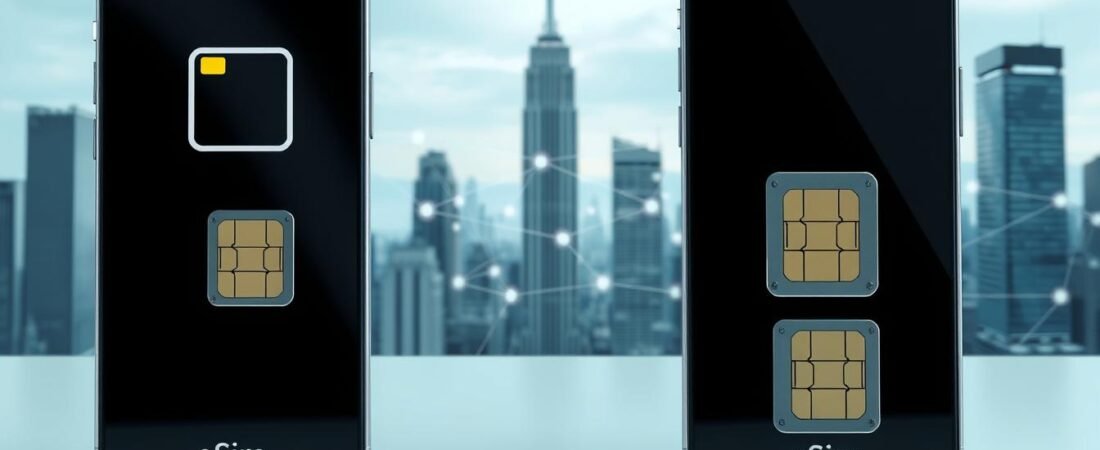
We’ve all been there – landing in a new country, excited to explore, but your phone shows no signal. That frustrating search for a local SIM vendor begins, cutting into precious vacation time. This common travel headache highlights why mobile connectivity options matter more than ever.
Today’s smartphones are rapidly evolving, with many models moving away from traditional card slots. Instead, they embrace embedded digital profiles that activate with a simple scan. This shift represents one of the most significant changes in how we stay connected.
Your choice between these technologies impacts everything from travel convenience to device compatibility. It even affects environmental footprint through reduced plastic waste. Understanding both options helps you make informed decisions about your mobile experience.
Major carriers and manufacturers worldwide are pushing digital adoption, making activation simpler across global networks. We’ll guide you through a clear comparison to determine which solution fits your lifestyle best.
ADVERT! ADVERT!! ADVERT!!!
Get Paid in Pounds — Right From Your Phone! 🇬🇧📱
Tired of searching for legit ways to make money online?
Here’s your chance to learn how people are earning in Pounds Sterling 💷 just by doing simple online surveys!
🔥 The Simplified Online Survey Guide shows you:
✅ Trusted survey platforms that actually pay 💵
✅ How to qualify for more surveys and earn faster
✅ Step-by-step guide — no experience needed
✅ Work from anywhere, anytime 🌍
👉 Don’t sleep on this! Start earning smarter today:
Your phone can be your ATM — if you take action now! 💪
Key Takeaways
- Digital profiles offer instant activation without physical cards
- Travel becomes simpler with remote network access
- Modern devices increasingly support embedded technology
- Environmental benefits come from reducing plastic waste
- Enhanced security features protect your mobile identity
- Global carriers support this evolving connectivity option
- Understanding both technologies helps you choose wisely
Introduction: The Changing Landscape of Mobile Connectivity
Remember digging through your bag for a paperclip to swap your SIM while traveling? Those days are quickly disappearing. A digital revolution is reshaping how we connect our devices to networks worldwide.
Major phone makers like Apple, Samsung, and Google now release flagship models without physical SIM trays in many markets. This shift toward embedded technology represents one of the biggest changes in mobile access.
Global carriers are expanding their support for digital activation methods. By 2025, nearly all major networks will offer app-based provisioning. Switching between carriers becomes as simple as scanning a QR code.
This transformation isn’t just about convenience. It affects device design, making phones sleeker and more water-resistant. The elimination of SIM trays allows for better internal space utilization.
For users in Nigeria and across Africa, understanding this evolution is crucial. Many budget-friendly devices and older models still rely on traditional cards. Knowing both technologies helps you make smart choices.
The benefits extend beyond personal convenience. Digital profiles reduce plastic waste from packaging and shipping. They also minimize the environmental impact of producing physical cards.
We’ll explore how these changes affect everyday life:
- Traveling without expensive roaming fees
- Managing multiple numbers on one device
- Enhanced security features for your mobile identity
- Quick network switching for better coverage
While the future appears digital, physical cards remain essential in areas with limited infrastructure. They ensure everyone can stay connected regardless of their device’s capabilities.
This introduction prepares you for a deeper understanding of both options. We’ll help you navigate these changes with confidence, whether you’re a student, professional, or frequent traveler.
Defining eSIM vs Physical SIM: The Future of Mobile Connectivity
Picture this: you arrive at a new destination, ready to share your adventures, but your phone won’t connect to local networks. This common experience highlights why knowing your connectivity options matters. We’ll break down both technologies to help you understand how they work.
Each option serves the same purpose but works differently. Your choice affects how you stay connected daily. Let’s explore what makes each technology unique.
What is a Physical SIM Card?
A physical SIM is that small plastic card you insert into your phone. It stores your subscriber information and connects you to your carrier’s network. These cards have been around since the 2G era.
They offer universal compatibility with almost all devices. This includes older phones and budget models common in Nigeria. You simply insert the card into your device’s tray.
Traditional SIM cards require manual handling. You often need to visit a store to get one. They’re physical objects that can be lost or damaged.
Despite newer options, these cards remain widely used. They provide reliable access to mobile networks worldwide. Many people still prefer their simplicity.
What is an eSIM?
An embedded SIM is a digital chip built into your device’s motherboard. It performs the same function as physical cards but works differently. You activate it through a QR code scan or carrier app.
This technology eliminates the need for physical swapping. It allows instant activation from anywhere with internet access. You can download profiles remotely without visiting stores.
eSIMs offer greater flexibility for users. You can store multiple carrier profiles on one device. This means you can have different plans active simultaneously.
They’re found in newer smartphones from brands like Apple and Samsung. Tablets and smartwatches also use this technology. It represents the evolving way we connect our devices.
ADVERT! ADVERT!! ADVERT!!!
📢 WhatsApp Automation – This Is How You Earn on Autopilot
Want to make money even when you’re asleep? 😴
With WhatsApp Automation, you set it up once — and let it work for you.
🔥 What you’ll learn:
- How to automate conversations & outreach on WhatsApp 🔄
- Best tools & setups that don’t look spammy
- Turning replies into income — without spending all your time chatting
- Proven strategies people are using to scale earnings
👉 Get access now:
Click here to unlock WhatsApp Automation
Turn WhatsApp into your silent earner. Let your phone do the talking. 💬💵
| Feature | Physical SIM | eSIM |
|---|---|---|
| Form Factor | Removable plastic card | Embedded digital chip |
| Activation Process | Manual insertion into tray | QR code scan or app download |
| Device Compatibility | Works with all phones | Newer smartphones and devices |
| Profile Storage | Single carrier at a time | Multiple profiles simultaneously |
| Security Features | Can be removed or lost | Non-removable and encrypted |
| Travel Convenience | Requires local SIM purchase | Remote activation before arrival |
Understanding these differences helps you make informed choices. Each technology has its place in today’s mobile landscape. Your needs will determine which option works best for you.
We’ll explore more detailed comparisons in the next sections. This foundation helps you appreciate why both technologies matter. Stay tuned for deeper insights into their advantages and limitations.
Core Technical Differences: How They Stack Up
Ever wondered why your friend’s new phone doesn’t have that tiny tray for a card? That’s because modern devices handle connectivity differently. We’re diving into the real technical distinctions that affect your daily mobile experience.
These differences go beyond just physical appearance. They impact how you set up service, switch networks, and manage multiple lines. Understanding these details helps you choose what works best for your lifestyle.
Form Factor and Installation Process
Traditional plastic cards require careful handling. You need that tiny ejector tool to access your phone’s SIM tray. The process involves physical insertion and proper alignment.
Digital chips eliminate this manual process entirely. They’re built directly into your device’s motherboard during manufacturing. This integration allows for sleeker phone designs without compromise.
Installation becomes a digital experience rather than physical. You activate service through QR codes or carrier apps instead of store visits. This saves time and reduces the risk of damaging small components.
Activation and Carrier Switching
Changing networks with physical cards means obtaining new plastic. You must visit stores or wait for mail delivery. This process can take hours or even days depending on your location.
Digital activation happens in minutes through your phone settings. You can switch carriers remotely without any physical interaction. This is particularly useful when traveling or needing immediate service changes.
Remote provisioning means you can activate service before arriving in a new country. No more airport SIM hunts or struggling with foreign languages at local shops. Your connectivity begins the moment you land.
Support for Multiple Profiles and Networks
Physical cards typically support one carrier profile at a time. Managing multiple numbers means carrying and swapping different cards. This becomes inconvenient when traveling or balancing work and personal lines.
Digital technology stores several profiles simultaneously on one device. You can switch between personal, work, and travel accounts with a few taps. No physical swapping or risk of losing tiny cards.
Network access remains identical for both technologies. However, digital profiles offer better flexibility when accessing local networks abroad. You maintain your primary number while adding temporary local data plans.
Security features also differ significantly. Digital chips can’t be physically removed or easily cloned. This reduces risks associated with SIM swapping fraud and identity theft.
These technical differences impact everything from device design to daily convenience. Your choice affects how quickly you can set up service and how securely you stay connected. We’ll help you determine which aspects matter most for your needs.
The Advantages of Choosing an eSIM
Imagine stepping off a plane and having local data already working on your phone. This seamless experience represents one of the biggest benefits of modern connectivity options. We’ll explore why many users are switching to digital solutions.
These advantages extend beyond just travel convenience. They include enhanced security features and environmental benefits too. Understanding these perks helps you make informed choices about your mobile experience.
Unmatched Convenience for Travelers
Digital activation eliminates the airport SIM hunt entirely. Services like SimCorner offer coverage in over 200 destinations worldwide. You can activate local data plans before your flight even lands.
No more searching for paperclips or struggling with tiny tray mechanisms. A simple QR code scan gets you connected within minutes. This is perfect when arriving tired after long flights.
Nigerian travelers can avoid expensive roaming charges this way. You maintain affordable access with local rates abroad. Staying connected becomes effortless and budget-friendly.

Enhanced Security and Device Design
Digital chips provide better protection for your mobile identity. They’re permanently installed and encrypted within your device. This reduces risks of theft compared to removable cards.
Device design improves significantly without physical tray requirements. Manufacturers can create sleeker profiles and larger batteries. Your phone becomes more durable and water-resistant too.
These security features protect against unauthorized profile changes. Your connectivity remains secure throughout your usage. This peace of mind matters for both personal and professional use.
Environmental Benefits and Flexibility
Digital technology eliminates plastic waste from card production. It also reduces carbon emissions from shipping physical products. This aligns with eco-friendly choices many users prefer today.
You gain incredible flexibility managing multiple profiles. One device can handle personal, work, and travel lines simultaneously. Switching between them takes just a few taps in your settings.
This flexibility benefits remote workers and students especially. You maintain separate numbers without carrying multiple devices. The convenience transforms how people manage their connectivity.
These advantages make digital profiles a smart choice for modern users. They offer convenience, security, and sustainability benefits. As more carriers adopt this technology, it becomes increasingly accessible.
By choosing this option, you’re selecting a forward-thinking solution. It simplifies connectivity in our mobile-first world beautifully. We believe these benefits will continue growing as technology evolves.
The Drawbacks and Limitations of eSIM Technology
While digital profiles offer exciting possibilities, they come with real limitations that affect many users. We want to give you the complete picture so you can make the best choice for your situation.
These challenges range from device compatibility issues to practical management concerns. Understanding them helps you avoid frustration when choosing your connectivity solution.
Device and Carrier Compatibility Hurdles
Many phones in Nigeria and across Africa cannot use digital profiles. Older models and budget-friendly devices typically lack this feature. This creates a significant barrier for users with these handsets.
Carrier availability varies dramatically across different regions. While major cities might offer full support, rural areas often have limited options. This uneven distribution affects users outside urban centers.
Global support remains inconsistent despite growing adoption. Some international carriers still don’t offer digital activation methods. Travelers might find themselves without expected connectivity options.
The Challenges of Transferring and Managing Profiles
Moving profiles between devices often requires carrier assistance. Unlike physical cards that you simply swap, digital transfers involve complex processes. This can take time and create temporary service disruptions.
Some users find the digital setup confusing compared to physical insertion. QR code scanning and app-based activation feel unfamiliar to many. The learning curve can discourage people from trying this technology.
Internet dependency creates another potential problem. You need stable online access to download and activate profiles. Areas with poor connectivity make this process difficult or impossible.
🎙️ Talk. Chat. Go Live.
💵 Get paid while doing it!
| Limitation Area | Specific Challenge | Impact on Users |
| Device Support | Older phones lack embedded chip technology | Limited access for budget-conscious users |
| Carrier Availability | Uneven global support and rural coverage gaps | Inconsistent service across regions |
| Profile Management | Complex transfer process between devices | Time-consuming setup and potential downtime |
| Activation Requirements | Internet connection needed for setup | Problems in areas with poor connectivity |
| User Experience | Digital process feels less tangible than physical cards | Learning curve for less tech-savvy users |
| Flexibility Concerns | Some carriers restrict profile changes | Reduced freedom to switch providers easily |
These limitations mean digital profiles aren’t the perfect solution for everyone. If you frequently change phones or use older devices, traditional options might serve you better. We believe understanding both strengths and weaknesses helps you choose wisely.
For Nigerian users, consider your local carrier support and device capabilities. Your individual needs should guide your decision rather than following trends. The right choice depends on your specific situation and requirements.
Why Physical SIM Cards Remain Relevant, Especially in Nigeria
Think about that moment when you need to quickly share your internet connection with a friend. You simply pop out your card and hand it to them. This everyday scenario shows why traditional connectivity methods still matter today.
In Nigeria and across Africa, these small plastic cards continue serving millions of users. They bridge gaps where newer technologies haven’t fully reached. Their simplicity makes them accessible to everyone.
Universal Device Support and Accessibility
Traditional cards work with virtually every phone on the market. From older feature phones to budget smartphones, compatibility is guaranteed. This universal support ensures nobody gets left behind.
You don’t need internet access or special apps for activation. This is crucial in areas with limited digital infrastructure. Rural communities and budget-conscious users benefit greatly.
Nigerian carriers offer extensive prepaid options for these cards. They’re available at countless retail locations nationwide. Getting connected takes minutes without complicated processes.
Simplicity and Control for the User
Physical control over your connectivity provides peace of mind. You can remove the card to completely disconnect from networks. This appeals to users concerned about privacy or emergency situations.
Swapping between devices becomes incredibly straightforward. No need for carrier assistance or profile transfers. Just move the card and you’re immediately connected.
Many users appreciate the tangible nature of this technology. The familiar insertion process feels more concrete than digital alternatives. This reduces learning curves for less tech-savvy individuals.
“The ability to physically control my connectivity gives me confidence in my privacy and security.”
These traditional options offer distinct advantages:
- Instant device sharing between family members or friends
- No internet dependency for activation or transfers
- Complete user control over network connections
- Widespread availability across Nigeria and Africa
- Budget-friendly accessibility for all income levels
While digital profiles gain popularity, physical solutions maintain strong relevance. They ensure everyone can stay connected regardless of location or device capabilities. This inclusive approach matters in diverse markets like Nigeria.
Both technologies have their place in today’s mobile landscape. Understanding their respective strengths helps you make the best choice for your needs. Sometimes, the simplest solution remains the most effective.
🎙️ Talk. Chat. Go Live.
💵 Get paid while doing it!
Choosing the Right Option for Your Needs in 2024
Making the smart choice between connectivity technologies requires understanding your specific needs. Your lifestyle, device capabilities, and location all influence which solution works best.
We’ll guide you through both scenarios to help you make an informed decision. The right choice depends on your individual circumstances rather than following trends.
When an Embedded SIM is the Ideal Choice
Frequent travelers benefit tremendously from digital profiles. You can activate global data plans before arriving in new countries.
Services like SimCorner offer coverage in over 200 destinations worldwide. This eliminates expensive roaming charges and airport SIM hunts.
Security-conscious users appreciate the encrypted protection. Digital chips cannot be physically removed or easily cloned like traditional cards.
Environmental benefits come from reducing plastic waste. This technology aligns with eco-friendly choices many prefer today.
Modern device owners find perfect compatibility. Newer iPhone and Samsung models support this technology seamlessly.
Multiple profile management becomes incredibly convenient. You can maintain work, personal, and travel lines on one device.
“The ability to have my work and personal numbers active simultaneously has transformed how I manage my connectivity.”
When a Physical Card is the Better Option
Budget-conscious users in Nigeria often prefer traditional solutions. Many affordable devices lack digital chip support.
Frequent SIM swappers appreciate the tangible control. Moving cards between devices takes seconds without carrier assistance.
Areas with limited digital infrastructure benefit from universal compatibility. Physical options work everywhere without internet dependency.
Students and young professionals value the simplicity. Prepaid options offer affordable access without technical complexity.
| Situation | Recommended Technology | Key Benefits |
|---|---|---|
| Frequent International Travel | Embedded Digital Profile | Instant activation, cost savings, multiple country support |
| Security Concerns | Embedded Digital Profile | Encrypted protection, non-removable security |
| Budget Device Usage | Traditional Physical Card | Universal compatibility, no device upgrade needed |
| Rural Area Residence | Traditional Physical Card | Reliable access, no internet dependency |
| Multiple Number Management | Embedded Digital Profile | Simultaneous profiles, easy switching |
| Frequent Device Sharing | Traditional Physical Card | Instant swapping, no carrier assistance required |
Consider a dual-SIM device if possible. This gives you flexibility to use both technologies as needed.
By weighing these factors, you can make an informed choice that keeps you connected efficiently throughout 2024.
Conclusion
Your journey through the world of mobile options ends here. We’ve compared two great ways to stay linked to the world.
Digital chips are growing fast. They bring easy setup and strong safety for your info. But plastic cards still work well for many people.
Your needs decide the best pick. Think about your phone, travel habits, and what feels simple.
Choose what fits your life now. Both methods help you talk, share, and explore every day.
We hope this guide made your choice clearer and simpler. Keep discovering tech that works for you!
🎙️ Talk. Chat. Go Live.
💵 Get paid while doing it!
FAQ
What is the main difference between an eSIM and a physical SIM card?
The main difference lies in their form. A physical SIM is a removable plastic card you insert into your phone, while an eSIM is a tiny, embedded chip soldered inside your device. This means no swapping cards—you can activate a plan digitally.
Can I use an eSIM and a physical SIM at the same time?
Yes! Many modern smartphones support Dual SIM functionality, allowing you to use both an eSIM and a physical SIM card simultaneously. This is perfect for separating work and personal numbers or using a local plan when traveling abroad.
Are eSIMs widely supported by carriers in Nigeria?
Support is growing but still limited compared to physical SIM cards. Major Nigerian networks are beginning to roll out eSIM support, but availability can vary. It’s best to check with your specific carrier for the most current information on eSIM plans and activation.
Is it easier to switch carriers with an eSIM?
Absolutely. Switching networks with an eSIM is often faster and more convenient. Instead of waiting for a new card in the mail or visiting a store, you can usually scan a QR code or download a profile to activate service with a new provider in minutes.
How secure is an eSIM compared to a physical SIM?
eSIM technology offers enhanced security. Since the chip is embedded in your device, it can’t be physically removed or stolen. This reduces the risk of SIM swap fraud, a common security concern with traditional SIM cards.
Do eSIMs work when I travel internationally?
Yes, and this is one of their biggest advantages. Before you travel, you can purchase a data plan from a local carrier in your destination country and activate it the moment you land—all without ever needing to find a store or swap out your primary SIM card.
What happens to my eSIM if I change phones?
You will need to transfer your eSIM profile to your new device. The process varies by carrier but often involves contacting them to deactivate the eSIM on your old phone and provide a new QR code for activation on the new one. It’s generally less seamless than moving a physical card.
Which phone models support eSIM technology?
Most newer iPhone models (from iPhone XS and later), Google Pixel devices, and a growing number of Samsung Galaxy phones support eSIM. Always check your specific device’s specifications to confirm eSIM compatibility before making a decision.